
Boardroom Confidence: 7 Habits of Executives Who Command the Room
Walk into any boardroom and you can usually tell within thirty seconds who’s going to be heard and who’s going to be talked over. It rarely comes down to job titles. It comes down to habits – small, consistent behaviours that either project confidence or quietly undercut it.
I’ve coached CXOs, founders, and senior managers across India for over 18 years, and the pattern is remarkably consistent. Boardroom confidence isn’t a personality trait some people are born with. It’s a set of habits, and habits can be built.
Here are the seven boardroom confidence habits I see, again and again, in executives who command a room, and how you can start building each one.
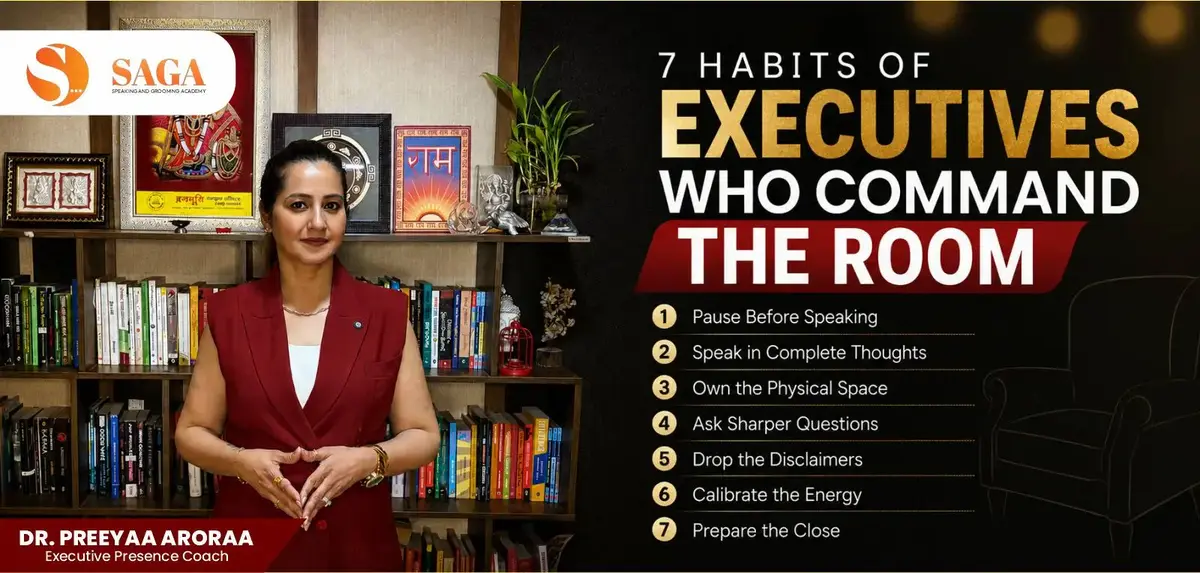
1. They Pause Before They Speak
The instinct in a high-pressure room is to fill silence immediately – to jump in with an answer the second a question lands. Executives who command the room do the opposite. They take a visible beat before responding.
That pause does two things. It signals that you’re actually thinking, not reacting. And it gives your answer more weight the moment it arrives, because the room has been waiting for it.
Try this: The next time you’re asked a pointed question in a meeting, count a slow “one, two” in your head before you answer. It will feel unnaturally long to you. It won’t feel long to anyone else.
2. They Speak in Complete Thoughts, Not Fragments
Watch a confident executive speak and you’ll notice their sentences tend to have a clear beginning, middle, and end. They don’t trail off, self-interrupt, or pepper their point with “sort of” and “I mean” until the original point disappears.
This isn’t about vocabulary – it’s about structure. A confident answer usually follows a simple shape: the point first, then the reasoning, then (if needed) the next step.
Try this: Before you speak in a high-stakes meeting, silently frame your point in one sentence first. Say that sentence. Then explain it. Resist the urge to explain your way into the point instead.
3. They Own the Physical Space, Without Overdoing It
Boardroom body language is a genuine skill, not an afterthought, and it’s often where otherwise capable executives lose the room without saying a word. Slouching, shrinking into a chair, or constantly touching your face or hair all signal discomfort – even when your actual points are strong.
The opposite mistake is just as common: taking up space aggressively, interrupting, or dominating the table in a way that reads as insecurity dressed up as confidence.
Try this: Sit with both feet grounded, shoulders relaxed but not slouched, and hands visible on the table rather than in your lap. It’s a small physical shift that changes how present you appear within minutes.
4. They Ask Sharper Questions Than Everyone Else
Junior executives tend to focus on having the right answers. Senior, confident executives are often more focused on asking the right questions – the ones that reframe a problem or expose an assumption no one else caught.
A well-placed question in a boardroom often carries more authority than a well-rehearsed answer, because it shows you’re thinking one level above the immediate discussion.
Try this: Before your next high-stakes meeting, prepare one genuinely difficult question in advance – not a softball, a real one. Save it for the moment the conversation needs redirecting.
5. They Don't Apologise for Taking Up Airtime
Many capable professionals, especially those newer to senior rooms, preface their points with soft openers – “This might be a silly question, but – ” or “I could be wrong, but -“. It’s a habit built from politeness, but in a boardroom it quietly discounts everything that follows.
Try this: Drop the disclaimer. State your point directly. If you’re genuinely unsure, say so plainly “I don’t have full visibility on this, so correct me” – which reads as confident precision, not hedging.
6. They Match Their Energy to the Room, Not the Other Way Around
Confident executives read the temperature of a room and calibrate – bringing calm into a tense discussion, or bringing focus into a scattered one. They don’t mirror the anxiety in the room; they steady it.
This is one of the more advanced habits, and it’s usually the last one to develop, because it requires genuine composure under pressure rather than performed calm.
Try this: In your next tense meeting, deliberately slow your own speaking pace and lower your volume slightly. It’s a subtle cue that shifts the room’s energy more than most people expect.
7. They Prepare the Close, Not Just the Opening
Most executives over-prepare their opening line and under-prepare how they want the discussion to end. Confident executives walk in already knowing what decision, agreement, or next step they want the room to leave with – and they steer the conversation toward it.
Try this: Before any important meeting, write down the one sentence you want to be true by the time everyone leaves the room. Let that sentence guide how you participate throughout.
Bonus: They Treat Confidence as a Practice, Not a Performance
This is the habit underneath all the others. Executives who genuinely command a room aren’t performing confidence for an audience – they’ve built it through repetition, in lower-stakes rooms, long before the high-stakes ones.
The genuine problem here: most professionals only try to “be confident” in the moments that matter most – the big pitch, the board review, the client call – which is exactly when it’s hardest to build a new habit. Confidence built only under pressure rarely holds under more pressure.
Try this: Practice these habits deliberately in low-stakes meetings first – pausing before you speak, asking a sharper question, dropping the disclaimer – so they’re already automatic by the time you’re in the room that actually matters.
Key Takeaways
1. Boardroom confidence is built from specific, repeatable habits – not personality or seniority alone.
2. Pausing before speaking and structuring your point clearly both signal composure instantly.
3. Body language and tone often communicate more authority than the content of what you say.
4. Confident executives ask sharper questions and prepare how they want a discussion to end, not just how it begins.
5. These habits need to be practised in low-stakes settings before they hold up under real pressure.
Boardroom confidence isn’t something you’re born with – it’s a skill you can build with the right coaching. If you’re preparing for a promotion, a board seat, or high-stakes client conversations, explore executive presence coaching with Dr. Preeyaa Aroraa and start building these habits before your next big room.
FAQs on "7 Habits of Executives Who Command the Room"
Boardroom confidence is the ability to communicate your point clearly, hold your position under scrutiny, and command attention in a high-stakes room - through a combination of body language, pacing, and structured thinking, not volume or aggression.
It's largely learned. Most executives who appear naturally confident have built these habits over years, often through deliberate practice or coaching, rather than being born with them.
Executive presence is the broader, ongoing impression you create across every interaction - how you communicate, look, and carry yourself day to day. Boardroom confidence is that presence applied specifically to high-stakes, high-pressure rooms.
Preparation of your closing point matters more than most people expect - walking in already knowing what you want the room to agree on by the end gives every other habit a clear direction.
Yes, significantly. Posture, eye contact, and physical stillness are processed by the room before your words are - which is why confident body language and confident speech need to be built together, not separately.
Dr. Preeyaa Aroraa holds a PhD in English, is a Certified NLP Super Coach and Image Consultant, and has spent 18+ years training professionals, executives, and students across India, the UK, the US, and Dubai. She is the author of the Amazon bestseller "Talk Your Way Up."